
Uncategorized
Torque Conversion Made Simple: Nm, in-lbs, ft-lbs and kgf-cm Explained
Sep
Your engineering drawing says 12 in-lbs.
The electric screwdriver you are considering is rated in Nm.
The torque meter on another workstation displays kgf-cm.
Now what?
Torque unit conversions are extremely common in manufacturing, assembly and industrial fastening. Different equipment manufacturers, engineering drawings and industries often use different units to describe exactly the same thing: rotational force.
The problem is that a conversion mistake can lead to selecting the wrong screwdriver, setting an incorrect torque value or creating a fastening process that does not match the engineering requirement.
Fortunately, torque conversion does not need to be complicated.
What Is Torque?
Torque is the rotational force applied around an axis.
In a fastening application, torque describes the twisting force being applied to a screw, bolt or other threaded fastener.
The amount of torque required depends on several factors, including the fastener, joint design, material, thread condition and desired clamp load.
Industrial torque screwdrivers are selected and adjusted around this requirement.
The challenge is that torque can be expressed using several different units.
The most common units you will encounter in production assembly include:
Newton-meters — Nm
Inch-pounds — in-lbs
Foot-pounds — ft-lbs
Kilogram-force centimeters — kgf-cm
They all describe torque.
They simply use different measurement systems.
Why Are There So Many Torque Units?
Manufacturing is global.
A component designed in Europe may specify torque in Newton-meters.
A North American engineering drawing may use inch-pounds.
An older piece of equipment or imported tool may display kgf-cm.
A higher-torque automotive application may use foot-pounds.
That means engineers and production teams frequently need to convert one unit into another before selecting or setting a fastening tool.
This is especially important when the required torque is relatively low.
A small conversion mistake at 0.5 Nm can represent a significant percentage of the total fastening requirement.
Nm: Newton-Meters
The Newton-meter is the standard SI unit for torque and is one of the most common units used for industrial fastening.
It is written as:
Nm
You will frequently see Kilews West electric screwdriver torque ranges specified in Nm.
For example, a tool might have a working range of:
0.20–1.18 Nm
or
0.98–2.94 Nm
If your engineering specification is already in Nm, matching it against a screwdriver’s torque range is straightforward.
If your specification is in another unit, you should convert it before selecting the tool.
Converting Nm to in-lbs
Inch-pounds are widely used for lower-torque fastening applications in North America.
A useful conversion is:
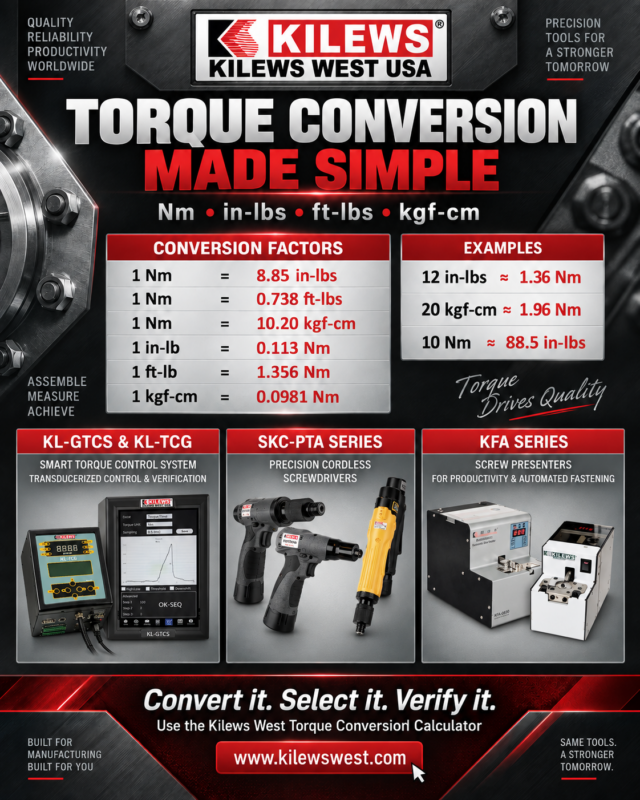
1 Nm ≈ 8.85 in-lbs
So if your application requires:
1 Nm
that is approximately:
8.85 in-lbs
If your application requires:
2 Nm
that is approximately:
17.70 in-lbs
And:
0.5 Nm ≈ 4.43 in-lbs
This conversion is particularly useful when comparing an engineering drawing specified in inch-pounds to a screwdriver specification listed in Newton-meters.
Example: 12 in-lbs to Nm
Suppose your engineering drawing specifies:
12 in-lbs
The conversion is approximately:
12 in-lbs ≈ 1.36 Nm
You would therefore look for an industrial screwdriver whose working torque range comfortably includes approximately 1.36 Nm.
That is much more useful than simply selecting the screwdriver with the highest maximum torque.
Converting Nm to ft-lbs
Foot-pounds are more common in higher-torque fastening applications.
The approximate conversion is:
1 Nm ≈ 0.738 ft-lbs
Or going in the opposite direction:
1 ft-lb ≈ 1.356 Nm
For example:
10 Nm ≈ 7.38 ft-lbs
20 Nm ≈ 14.75 ft-lbs
50 Nm ≈ 36.88 ft-lbs
You are more likely to encounter ft-lbs when dealing with larger bolts, automotive components or higher-torque cordless fastening equipment.
For small precision assembly, Nm and in-lbs are generally more common.
Converting kgf-cm to Nm
Kilogram-force centimeters are still found on some industrial equipment, torque testers and screwdriver specifications.
The approximate conversion is:
1 kgf-cm ≈ 0.0981 Nm
Going the other direction:
1 Nm ≈ 10.20 kgf-cm
For example:
10 kgf-cm ≈ 0.98 Nm
20 kgf-cm ≈ 1.96 Nm
30 kgf-cm ≈ 2.94 Nm
You may notice those values appear frequently in industrial screwdriver specifications because many tools were originally engineered around kilogram-force centimeter ranges before being converted to Nm and in-lbs for international markets.
Quick Torque Conversion Reference
| Starting value | Approximate equivalent |
|---|---|
| 1 Nm | 8.85 in-lbs |
| 1 Nm | 0.738 ft-lbs |
| 1 Nm | 10.20 kgf-cm |
| 1 in-lb | 0.113 Nm |
| 1 ft-lb | 1.356 Nm |
| 1 kgf-cm | 0.0981 Nm |
These values are useful for quick reference, but when selecting production fastening equipment, using a torque conversion calculator helps reduce the chance of transcription or calculation errors.
Why Torque Conversion Errors Matter
It is easy to look at a conversion as a simple math problem.
On an assembly line, however, the converted value may directly determine how a fastening tool is selected or adjusted.
Imagine an application requiring:
12 in-lbs
That is approximately:
1.36 Nm
If someone accidentally treats 12 in-lbs as 12 Nm, they have not made a small error.
They have selected a value almost nine times greater than the actual requirement.
Depending on the application, that could damage the fastener, strip threads, crack plastic, damage an insert or destroy the component being assembled.
Unit mistakes can have expensive consequences.
Never Assume the Units
A number on an engineering drawing means very little without the unit beside it.
For example:
10 Nm
is very different from:
10 in-lbs
10 Nm is approximately:
88.5 in-lbs
That is a massive difference.
Before setting a torque screwdriver, always confirm:
the required value, the required unit and whether the screwdriver or controller is displaying the same unit.
If the units are different, convert the value first.
Convert the Torque Before Choosing the Screwdriver
Torque conversion is also an important part of tool selection.
Suppose an engineering drawing specifies:
15 in-lbs
That converts to approximately:
1.69 Nm
Now you can compare that requirement against Kilews West screwdriver torque ranges.
Instead of asking:
“Which screwdriver has the most torque?”
you can ask:
“Which screwdriver has a working range that comfortably includes 1.69 Nm?”
That is a much better way to select an industrial fastening tool.
Your Target Torque Should Sit Within the Tool’s Working Range
A common purchasing mistake is selecting a screwdriver simply because its maximum torque exceeds the target.
For example, if your application requires 1 Nm, a screwdriver capable of 20 Nm is not automatically better.
The goal is to select a tool whose working torque range matches the application.
Ideally, your required torque should sit comfortably inside the usable range rather than directly at the extreme minimum or maximum.
This generally gives you a more appropriate tool for the fastener, joint and operator.
Torque Conversion Is Only Step One
Converting the engineering requirement into the correct unit tells you the target.
It does not tell you everything about the fastening application.
After establishing the torque requirement, you should also consider:
fastener size and length, material, joint type, screwdriver speed, inline versus pistol-grip or right-angle configuration, corded versus cordless operation, production volume and whether torque verification or fastening traceability is required.
That is why torque conversion and tool selection work naturally together.
First convert the requirement.
Then find the tool that matches it.
How Do You Verify the Converted Torque?
Once a screwdriver has been selected and set, the actual tool output should be verified.
Kilews West offers KTM torque meters designed for checking electric screwdriver performance.
The KTM family includes measurement ranges covering approximately:
KTM-15: 0.01–1.47 Nm
KTM-150: 0.15–14.7 Nm
KTM-250: 0.29–24.5 Nm
A torque meter allows the production or quality team to confirm that the screwdriver output corresponds with the required fastening process.
That becomes particularly important when converting between units because the objective is not merely to calculate the correct number.
The objective is to produce the correct torque at the fastener.
Torque Conversion and Torque Accuracy Are Different
Another important distinction is the difference between unit conversion and tool accuracy.
Suppose your target is:
1 Nm
That converts to approximately:
8.85 in-lbs
Those two values represent the same nominal torque.
But an industrial screwdriver may also have a torque accuracy specification such as ±3%.
That specification describes the tool’s performance under defined test conditions.
It does not change the conversion.
You still convert 1 Nm to approximately 8.85 in-lbs.
The torque accuracy specification then becomes part of evaluating how consistently the screwdriver can produce the intended result.
Use the Kilews West Torque Conversion Calculator
You do not need to manually calculate every conversion.
The Kilews West Torque Conversion Calculator is designed to make it easier to convert common industrial fastening units before selecting or setting a tool.
A strong workflow is:
Engineering torque requirement → Convert the unit → Identify the target torque → Select the correct screwdriver range → Verify the tool output
This reduces guesswork and gives engineering, purchasing and production teams a consistent way to communicate fastening requirements.
Already Know Your Torque?
Once you have converted your required torque, the next step is finding the correct fastening tool.
Use the Kilews West Tool Finder to narrow your options based on factors including torque range, tool style, application, fastener, corded or cordless operation and traceability requirements.
That creates a simple process:
Convert it.
Find it.
Verify it.
Fasten it.
Better Fastening Starts With the Correct Number
Torque conversion may seem like a small part of manufacturing.
But the entire fastening process can depend on getting that number right.
A correct conversion helps you:
select the correct screwdriver, establish the correct process target, communicate requirements consistently between engineering and production, verify tool performance and reduce the chance of costly setup errors.
Whether your specification arrives in Nm, in-lbs, ft-lbs or kgf-cm, the goal remains the same:
Apply the correct amount of torque to the correct fastener—consistently.
Kilews West USA
Top Quality. Excellent Service. Progressive Design.
