
Uncategorized
Why Torque Range Matters More Than Maximum Torque
13
Sep
Sep
A lot of buyers see a screwdriver that can reach a higher torque and assume it is automatically the better tool. That is not how production fastening works.
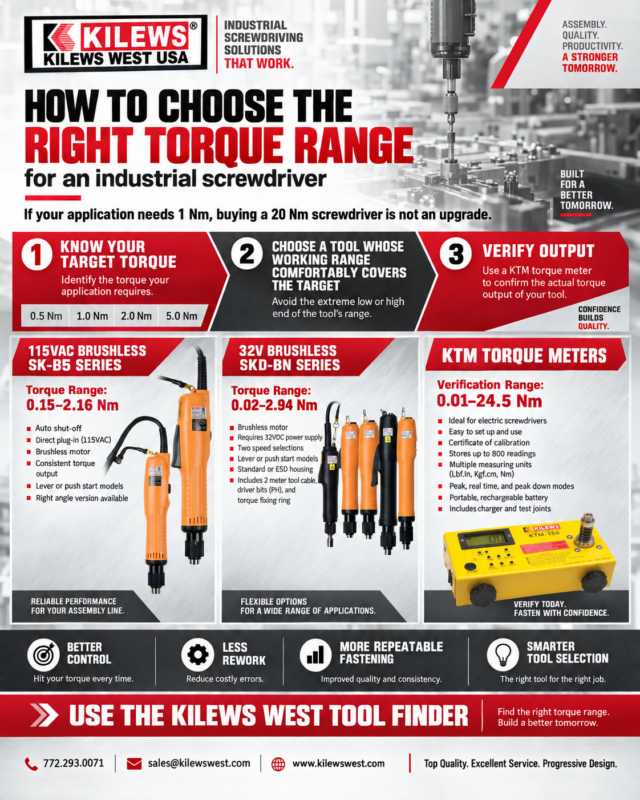
The article could explain why the working torque range matters more than the headline maximum, why you do not want your target torque sitting right at the extreme low or high end of a tool’s range, and how oversizing a screwdriver can hurt control, ergonomics, and repeatability.
It would naturally cover topics like:
- choosing a tool around the target torque
- low-torque vs. high-torque applications
- why “more powerful” is not always better
- matching torque range to screw size and joint type
- when to move from 32V to 115V or higher-torque systems
- when cordless makes sense
- when you need a torque meter to verify output
- how to use the Kilews West Tool Finder to narrow the options
A good SEO title would be:
How to Choose the Right Torque Range for an Industrial Screwdriver
And the hook could be:
“If your application needs 1 Nm, buying a 20 Nm screwdriver is not an upgrade.”
