
Uncategorized
What Does ±3% Torque Accuracy Actually Mean?
Sep
When you are selecting an industrial electric screwdriver, you will often see specifications such as:
Torque Accuracy: ±3%
For an engineer, quality manager or experienced manufacturing professional, that specification may look familiar.
For a purchasing manager or someone building a fastening process for the first time, it can be less obvious.
Does ±3% mean the screwdriver is allowed to miss the target by 3%?
Does it mean every screw will finish within exactly that range?
Is torque accuracy the same thing as torque repeatability?
And how does that number affect the quality of your assembly?
Understanding what torque accuracy actually means can help you select the correct fastening equipment—and avoid making purchasing decisions based on a specification you may be interpreting incorrectly.
Torque Accuracy in Plain English
Torque is rotational force.
When an electric torque screwdriver is adjusted for a fastening operation, the objective is to apply a controlled amount of torque to the fastener.
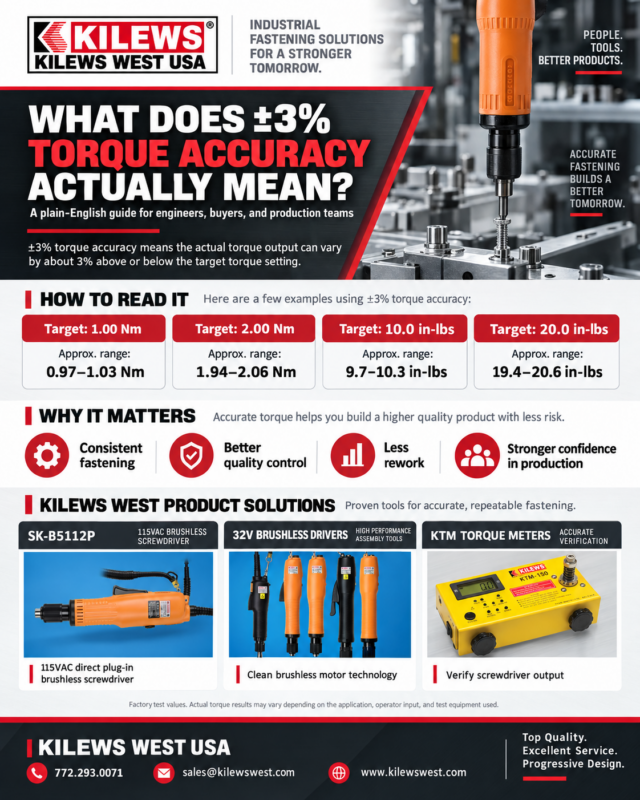
If a screwdriver is specified at ±3% torque accuracy, a simple way of understanding the specification is that the measured torque under the manufacturer’s defined test conditions should remain very close to the intended torque value.
For example, 3% of a 1.00 Nm target is:
0.03 Nm
So a simplified ±3% range around 1.00 Nm would be approximately:
0.97 Nm to 1.03 Nm
At a 2.00 Nm target:
3% of 2.00 Nm = 0.06 Nm
That produces a simplified range of:
1.94 Nm to 2.06 Nm
The same idea can be applied to inch-pounds.
| Target torque | 3% of target | Simplified ±3% range |
|---|---|---|
| 0.50 Nm | 0.015 Nm | 0.485–0.515 Nm |
| 1.00 Nm | 0.03 Nm | 0.97–1.03 Nm |
| 2.00 Nm | 0.06 Nm | 1.94–2.06 Nm |
| 5.00 Nm | 0.15 Nm | 4.85–5.15 Nm |
| 10.0 in-lbs | 0.3 in-lbs | 9.7–10.3 in-lbs |
| 20.0 in-lbs | 0.6 in-lbs | 19.4–20.6 in-lbs |
That is the easiest way to visualize what a ±3% specification represents.
But there is an important detail.
±3% Does Not Mean Every Real-World Fastener Will Always Land Inside That Exact Window
Torque-tool specifications are established under controlled test conditions.
The actual torque obtained in production can also be influenced by the application itself.
Kilews West specifically notes in its screwdriver literature that its torque-accuracy figures are factory test values and that actual torque results can vary depending on the specific application, operator input and test equipment used.
That distinction matters.
The ±3% specification tells you something about the performance capability and consistency of the tool.
It does not eliminate variation caused by the joint.
Two fastening applications using the same screwdriver and torque setting can behave differently because of differences in:
thread friction, screw coatings, material, lubrication, joint stiffness, hole quality, operator technique and the test method being used.
That is why a production fastening process should be validated on the actual assembly, rather than relying only on the number printed in a catalogue.
Torque Accuracy vs. Torque Repeatability
These two terms are related, but they are not exactly the same thing.
Accuracy describes how close a result is to the intended or reference value.
Repeatability describes how consistently the fastening process produces similar results cycle after cycle.
Imagine that a target is set at 1.00 Nm.
Tool A repeatedly produces:
0.99, 1.00, 1.01, 1.00, 0.99 Nm
That process is very repeatable and very close to the target.
Tool B repeatedly produces:
0.91, 0.92, 0.91, 0.92, 0.91 Nm
Those results are quite repeatable—but they are not especially close to the 1.00 Nm target.
Tool C produces:
0.90, 1.08, 0.95, 1.07, 0.91 Nm
That process has poor repeatability because the results vary considerably.
For production manufacturing, you generally want both accuracy and repeatability.
A tool needs to perform near the required target, but it also needs to do so consistently across hundreds or thousands of fastening cycles.
Why Does ±3% Matter on an Assembly Line?
A few percent may sound insignificant.
Across a high-volume production operation, however, fastening variation can contribute to real quality problems.
If torque is too low, a joint may not have sufficient clamp load.
That can contribute to loosening, movement, noise, leakage or premature failure depending on the assembly.
If torque is too high, another set of problems can occur.
Threads may become damaged. Plastic components can crack. Inserts can pull out. Fasteners can stretch or break. Sensitive components may be damaged.
Controlled fastening reduces that uncertainty.
Instead of relying entirely on operator feel, an industrial torque screwdriver is designed to make the fastening process more predictable.
An Example From the Kilews West 32V Brushless Family
The Kilews West 32V brushless electric screwdriver family is specified with consistent torque output and ±3% torque accuracy under the stated factory-test conditions.
The family covers approximately 0.02 to 2.94 Nm and includes lever-start and push-start models, multiple speeds and standard or ESD housing options.
Consider an application requiring approximately 1.00 Nm.
A simplified ±3% calculation gives:
1.00 × 0.03 = 0.03 Nm
That gives a theoretical window of:
0.97–1.03 Nm
However, the production process should still be tested using the actual screw, material and joint.
That real-world validation determines whether the selected screwdriver, speed and torque setting consistently produce an acceptable finished joint.
The Same Principle Applies to 115V Direct Plug-In Screwdrivers
Kilews West also specifies ±3% torque accuracy for its SK-B Series 115VAC brushless electric screwdrivers.
These tools combine brushless motor technology with direct 115VAC operation, eliminating the need for a separate screwdriver power supply in many workstation configurations.
For example, the SK-B5112P operates across a torque range of approximately 0.20–1.18 Nm and runs at 1,200 RPMwith push-start operation.
If an application requires a target around 1 Nm, this type of screwdriver places that target comfortably within the tool’s operating range.
That is generally preferable to selecting a tool whose required fastening torque sits at the extreme edge of its available range.
Why You Should Not Select a Screwdriver Based on Accuracy Alone
Torque accuracy is important.
It is not the only specification that determines whether a screwdriver is suitable for your production line.
You also need to consider the screwdriver’s torque range, RPM, start type, joint characteristics, fastener size, tool style, duty cycle and how the torque will be verified.
A screwdriver can have an impressive accuracy specification and still be the wrong tool for the application.
For example, an extremely high-speed screwdriver may not be ideal for a sensitive plastic assembly.
A large high-torque screwdriver may be unnecessarily heavy for a low-torque electronics application.
A straight inline tool may be impossible to use if the fastener is buried inside the assembly.
Proper tool selection looks at the entire fastening process.
How Do You Know What Torque the Screwdriver Is Actually Producing?
You measure it.
Torque verification is an essential part of a controlled fastening program.
Kilews West offers the KTM torque meter family for checking electric screwdriver output.
The current catalog lists:
KTM-15: 0.01–1.47 Nm
KTM-150: 0.15–14.7 Nm
KTM-250: 0.29–24.5 Nm
The KTM torque meters are specified at ±0.5% measurement accuracy, can store up to 800 readings and can display minimum, maximum and average torque results for groups of rundowns.
This allows a manufacturer to periodically verify that a screwdriver continues performing as expected.
Why Verification Matters Even With a ±3% Screwdriver
Think of the screwdriver specification as one piece of the quality system.
The screwdriver controls the fastening process.
The torque meter verifies it.
The assembly itself validates whether the process is suitable.
Those three pieces work together.
This is particularly important because fastening results can change over time as production conditions change.
A new batch of screws may have a different coating.
A supplier may change a molded component.
A thread-forming screw may encounter different material characteristics.
Operator technique may change.
Tool components can wear.
Regular torque verification helps manufacturers identify these changes before they develop into larger quality problems.
Accuracy Becomes Even More Important as the Joint Becomes More Critical
Not every screw requires the same level of control.
A non-critical enclosure screw and a critical structural fastener may have very different quality requirements.
As joint criticality increases, manufacturers may move through several levels of fastening control.
A conventional shut-off clutch screwdriver may be sufficient for many assembly operations.
A torque meter can be added for periodic verification.
For more demanding applications, a transducerized fastening system can electronically monitor the fastening operation.
For even greater process control, torque and angle can be monitored together and fastening results can become part of the production data record.
The appropriate level of control depends on the risk and quality requirements of the assembly.
What Does ±3% Mean for Purchasing Teams?
For purchasing departments, torque accuracy can be a useful comparison point—but it should never be evaluated in isolation.
When comparing two industrial screwdrivers, ask more than:
“Which one has the better accuracy number?”
A more useful question is:
“Which fastening system can repeatedly produce the result our assembly requires?”
That means considering the complete cost and capability of the tool.
A lower-cost screwdriver that creates more rework, requires additional maintenance or cannot consistently perform within the required process window may ultimately be more expensive.
Likewise, buying a highly sophisticated fastening system for an application that does not require that level of control can unnecessarily increase equipment cost and complexity.
The objective is to match the technology to the application.
A Practical Way to Think About ±3%
The simplest explanation is:
±3% describes how closely the screwdriver is designed to control torque under specified test conditions.
It is an indication of the tool’s precision.
It is not a promise that every screw in every material will automatically finish exactly within a mathematical ±3% window.
Real fastening results still depend on the joint, fastener, operator and verification method.
That is why professional production fastening involves both tool selection and process validation.
Build a More Repeatable Fastening Process
Kilews West offers multiple levels of controlled fastening technology, including brushless electric screwdrivers, torque meters and transducerized fastening systems.
Whether your application needs a straightforward ±3% brushless screwdriver or advanced torque-and-angle process monitoring, the starting point should always be the requirements of the actual assembly.
Define the target torque.
Select the correct torque range.
Choose the appropriate speed and tool configuration.
Verify the output.
Then test the process on the actual joint.
That is how a torque specification becomes a repeatable manufacturing process.
Kilews West USA
772.293.0071
sales@kilewswest.com
www.kilewswest.com
Top Quality. Excellent Service. Progressive Design.
