
Uncategorized
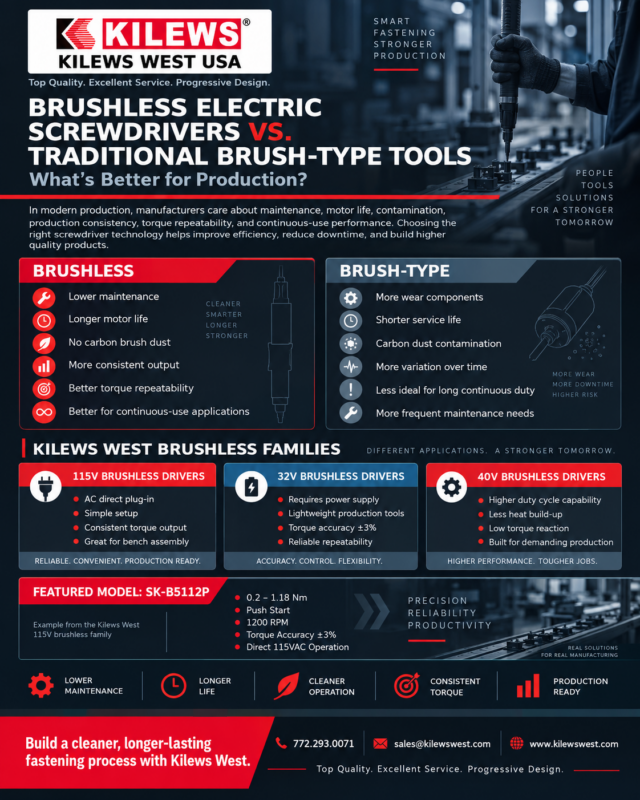
Brushless Electric Screwdrivers vs. Traditional Brush-Type Tools: What’s Better for Production?
Sep
In a production environment, an electric screwdriver is not just a hand tool.
It is part of the manufacturing process.
When a fastening tool is used hundreds or thousands of times during a shift, factors such as maintenance, motor life, heat, contamination, torque consistency and downtime can have a major impact on productivity.
That is one of the reasons brushless electric screwdrivers have become increasingly important in modern assembly environments.
Traditional brushed motors can still work well in certain applications, but for manufacturers focused on repeatable fastening and continuous production, brushless technology offers several important advantages.
What Is the Difference Between a Brushed and Brushless Motor?
Traditional electric motors use carbon brushes to transfer electrical current to the rotating portion of the motor.
Those brushes physically contact components inside the motor.
As the motor operates, the brushes gradually wear.
Brushless motors eliminate those mechanical brushes and instead use electronic motor control.
Removing that wear component changes several important characteristics of the tool.
For production facilities, that can mean:
Less maintenance
Longer motor life
Less contamination
Lower heat generation
More consistent performance
Better suitability for continuous operation
The difference becomes increasingly important as fastening volume increases.
1. Maintenance Requirements
One of the most obvious differences between brush-type and brushless screwdrivers is maintenance.
Carbon brushes are wear components.
Over time they eventually require inspection and replacement.
For a tool being used occasionally, this may not represent a major issue.
But in a production environment running multiple shifts, maintenance intervals can become much more important.
Every time a production screwdriver is removed from service, there can be additional costs associated with:
- tool maintenance
- technician time
- replacement parts
- spare tooling
- production interruptions
- lost assembly time
Brushless motors eliminate the carbon brushes themselves, reducing one common source of motor maintenance.
For manufacturers operating multiple fastening stations, those savings can add up quickly.
2. Longer Motor Life
Reducing mechanical wear inside the motor can also contribute to longer operating life.
Brushless tools are well suited for environments where screwdrivers are expected to perform repeated fastening cycles throughout the day.
Kilews West describes its brushless screwdriver technology as providing dependable, long-lasting operation while maintaining consistent fastening performance.
For production managers, a longer-lasting fastening tool can mean fewer replacements and greater confidence in the equipment being used on the assembly line.
3. Cleaner Operation and Less Contamination
Carbon brushes gradually wear as a brushed motor operates.
That wear can create carbon dust.
In many industrial applications, a small amount of contamination may not be a major concern.
However, cleanliness becomes much more important in manufacturing environments involving:
- electronics
- electrical components
- medical devices
- precision equipment
- clean assembly areas
- sensitive components
Brushless motor technology eliminates carbon-brush dust generated by the motor itself.
Kilews West specifically identifies its brushless systems as clean motor technology, while 40V brushless systems are designed to operate without carbon-brush contamination.
That can make brushless screwdrivers particularly attractive for clean and precision assembly environments.
4. More Consistent Production Performance
Production fastening is about consistency.
A screwdriver may perform perfectly during the first hour of a shift, but manufacturers need that performance to remain dependable after hundreds or thousands of fastening cycles.
Brush wear, heat and mechanical deterioration can eventually affect the behavior of conventional motors.
Brushless systems eliminate one of those mechanical wear points.
Kilews West’s brushless screwdriver families are designed around consistent torque output and repeatable fastening performance.
For example, the SK-B5112P is rated for ±3% torque accuracy and is designed to provide consistent torque output in production applications.
That type of repeatability is especially important when manufacturers are assembling products where fastener consistency directly affects quality.
5. Torque Repeatability Matters More Than Maximum Torque
When choosing an industrial screwdriver, manufacturers sometimes focus heavily on maximum torque.
But maximum torque is only part of the equation.
In many production applications, repeatability is more important.
If a fastening process requires a specific torque, the objective is not simply to reach that value once.
The objective is to achieve a consistent result:
Cycle after cycle.
Operator after operator.
Shift after shift.
Reliable torque control helps manufacturers reduce variation in the assembly process.
This can support:
- better product consistency
- fewer fastening defects
- reduced rework
- improved quality control
- more predictable production
The goal is not simply a powerful screwdriver.
The goal is a repeatable fastening process.
6. Brushless Motors Are Better Suited for Continuous Production
Heat is another important factor.
A production screwdriver may operate hundreds of times per hour.
As duty cycle increases, heat management becomes increasingly important.
Brushless motor systems generally generate less heat associated with brush friction and are well suited for higher-duty-cycle applications.
Kilews West’s 40V brushless screwdriver technology is specifically designed for demanding production environments and higher duty cycles compared with conventional brush motors.
That can make higher-voltage brushless systems particularly useful in applications where tools are expected to operate repeatedly throughout extended production periods.
The Kilews West Brushless Screwdriver Families
Kilews West offers multiple brushless screwdriver platforms designed for different fastening requirements.
Kilews West currently supports 115VAC, 32VDC and 40VDC brushless screwdriver systems, allowing manufacturers to select a platform based on torque requirements, production volume and workstation configuration. Kilews West also states that these brushless screwdriver families are assembled at its Florida facility.
115V Brushless Electric Screwdrivers
The 115V brushless screwdriver family offers a simple approach to industrial fastening.
These tools plug directly into a standard 115VAC electrical receptacle.
That means a separate external screwdriver power supply is not required for the basic setup.
This can simplify workstation installation while still providing industrial brushless motor performance.
One example is the Kilews SK-B5112P.
The SK-B5112P features:
- 0.2–1.18 Nm torque range
- 1.77–10.44 in-lbs
- 1,200 RPM
- push-start operation
- brushless motor technology
- ±3% torque accuracy
- direct 115VAC operation
- 110–120VAC input
- integral 3-meter power cord
Kilews West also describes the tool as providing consistent torque output and dependable long-term operation.
For manufacturers looking for a straightforward production screwdriver that can plug directly into standard plant power, the 115V platform can be an attractive solution.
32V Brushless Electric Screwdrivers
The 32V brushless family takes a different approach.
These screwdrivers operate through an external DC power supply.
The external controller/power-supply architecture allows manufacturers to build fastening stations around lightweight industrial screwdrivers while selecting the appropriate power supply for the application.
For example, the SKD-BN5019L provides:
- 0.29–1.86 Nm torque range
- 2.6–16.5 in-lbs
- selectable 1,000 / 700 RPM speeds
- ±3% torque accuracy
- brushless motor technology
- lever-start operation
- standard or ESD-safe housing options
- lightweight 520 g construction
A compatible 32VDC power supply is required.
For operators performing repetitive assembly work, the combination of low tool weight and controlled DC power can be especially useful.
The 32V family is available across several torque ranges, allowing manufacturers to match the screwdriver more closely to their assembly requirements.
40V Brushless Electric Screwdrivers
For more demanding assembly applications, the 40V brushless platform provides additional performance capability.
These systems are designed for higher duty cycles and applications that may require greater torque.
Kilews West’s 40V brushless technology emphasizes:
- precise torque control
- low torque reaction
- brushless operation
- no carbon-brush dust
- reduced heat build-up
- higher duty-cycle capability
- production-oriented durability
These characteristics make 40V systems particularly well suited for demanding industrial assembly environments where the screwdriver may be operating continuously throughout the shift.
Which Brushless System Is Right for Your Production Line?
There is no single screwdriver platform that is ideal for every fastening application.
The right system depends on several factors.
Manufacturers should consider:
Required torque range
A low-torque electronics assembly station has very different requirements from a higher-torque mechanical assembly application.
Production volume
Tools operating occasionally may have different requirements than tools completing thousands of fastening cycles per shift.
Duty cycle
Higher-volume production may benefit from systems designed specifically for continuous operation.
Workstation configuration
Some manufacturers prefer direct AC plug-in tools, while others prefer screwdriver systems using centralized DC power supplies.
Operator ergonomics
Tool weight, grip design, start method and torque reaction can all affect operator comfort during repetitive production.
ESD requirements
Electronics manufacturing may require ESD-safe tool configurations.
Fastener type
Screw size, material and joint characteristics can influence the ideal torque range and screwdriver configuration.
Brushless vs. Brush-Type: Which Is Better?
For light or occasional use, a traditional brushed electric motor can still be perfectly adequate.
But production assembly presents a different set of priorities.
Manufacturers increasingly need tools that can operate repeatedly while maintaining predictable performance.
That is where brushless screwdrivers offer some of their greatest advantages.
Compared with conventional brush-type tools, brushless technology can provide:
- reduced maintenance
- longer motor life
- cleaner operation
- reduced carbon contamination
- lower heat generation
- greater duty-cycle capability
- consistent torque output
- dependable fastening repeatability
The higher the production volume, the more valuable these characteristics can become.
The Real Question Is Not Just Which Tool Costs Less
Purchase price matters.
But production managers should also consider the total cost of operating the fastening system.
A less expensive screwdriver may become more expensive over time if it requires frequent maintenance, motor service, replacement tools or production interruptions.
The real calculation should include:
Tool cost
Maintenance cost
Downtime
Replacement parts
Production consistency
Quality defects
Tool lifespan
Operator productivity
A fastening tool is part of the production process.
Its value should be measured the same way.
Build the Right Fastening System With Kilews West
Kilews West offers brushless electric screwdriver systems for a wide range of assembly environments.
From straightforward 115VAC direct plug-in screwdrivers, to lightweight 32VDC systems, to 40VDC brushless platforms built for demanding production, manufacturers can select a fastening system that matches the requirements of their application.
The objective is simple:
Less maintenance.
Longer life.
Cleaner operation.
Consistent torque.
Better production.
If you’re unsure which torque range, voltage platform or screwdriver configuration is right for your assembly process, contact Kilews West.
Kilews West USA
772.293.0071
sales@kilewswest.com
www.kilewswest.com
