
Uncategorized
Smart Fastening in 2026: Why Torque + Angle + Traceability Matter More Than Ever
Sep
For years, industrial fastening was primarily focused on one question:
Did the fastener reach the required torque?
In modern manufacturing, that question is no longer enough.
Today’s production environments increasingly demand proof that a fastening operation was completed correctly. Manufacturers need greater control over the process, better quality documentation and the ability to identify problems before a product moves further down the assembly line.
That means looking beyond torque alone.
Modern smart fastening systems can monitor torque, angle, fastening parameters, cycle results and production data, giving manufacturers a much clearer picture of what actually happened during every controlled fastening operation.
This shift from simply tightening a fastener to verifying the fastening process is becoming an important part of modern assembly.
Tightening a Screw Is Not the Same as Verifying the Joint
A conventional fastening system may be able to stop a screwdriver when a predetermined torque level is reached.
That works for many applications.
But reaching a torque value does not always tell the entire story.
For example, what if:
- the fastener cross-threaded before reaching its proper position?
- the screw reached torque earlier than expected?
- the fastener rotated farther than the acceptable range?
- the wrong fastener was installed?
- the operator missed a fastening location?
- a process parameter changed?
- the manufacturer later needed proof that a specific fastening cycle passed?
This is where transducerized fastening systems become increasingly valuable.
Instead of simply controlling the tool, a smart fastening system can provide feedback about the fastening event itself.
Torque Tells You How Tight. Angle Tells You More About How You Got There.
Torque remains one of the most important measurements in controlled fastening.
But torque combined with angle monitoring provides manufacturers with another layer of process information.
Torque measures the rotational force applied during the fastening process.
Angle measures how far the fastener rotates during a defined portion of the fastening cycle.
Monitoring both can help manufacturers better understand whether the fastener behaved as expected.
Consider two screws that both reach the same final torque.
One may have followed the expected fastening profile.
The other may have reached the same torque after significantly less or significantly more rotation.
The final torque number might look correct, but the fastening events were not necessarily identical.
By monitoring torque and angle together, manufacturers can establish more detailed acceptance criteria for critical assembly operations.
From Torque Control to Process Control
This represents one of the biggest changes happening in industrial fastening.
The objective is no longer simply:
Tighten this screw to X torque.
The objective becomes:
Run the correct fastening program, monitor the fastening cycle, confirm that the process remains within established limits and record the result.
That is a significant difference.
Modern fastening stations can be configured around multiple parameters such as:
Torque
Angle
Speed
Time
Direction
Fastening sequences
OK / NG results
Job programs
Production data
This allows the fastening tool to become part of a larger manufacturing quality-control process rather than operating as an isolated piece of equipment.
Why Traceability Is Becoming So Important
Connected manufacturing is producing more data than ever before.
Fastening equipment is becoming part of that connected environment.
Digital torque tools and connected fastening systems can help manufacturing and quality teams capture tightening information, confirm results and integrate fastening data into broader production systems.
This can be particularly valuable when manufacturers need to document how a component was assembled.
Instead of knowing only that a product passed final inspection, production teams can have information about the fastening processes used to build it.
Traceability can help support:
- quality-control documentation
- error detection
- process improvement
- production audits
- troubleshooting
- operator feedback
- manufacturing analytics
- continuous improvement programs
For high-value or safety-critical assemblies, that information can become extremely important.
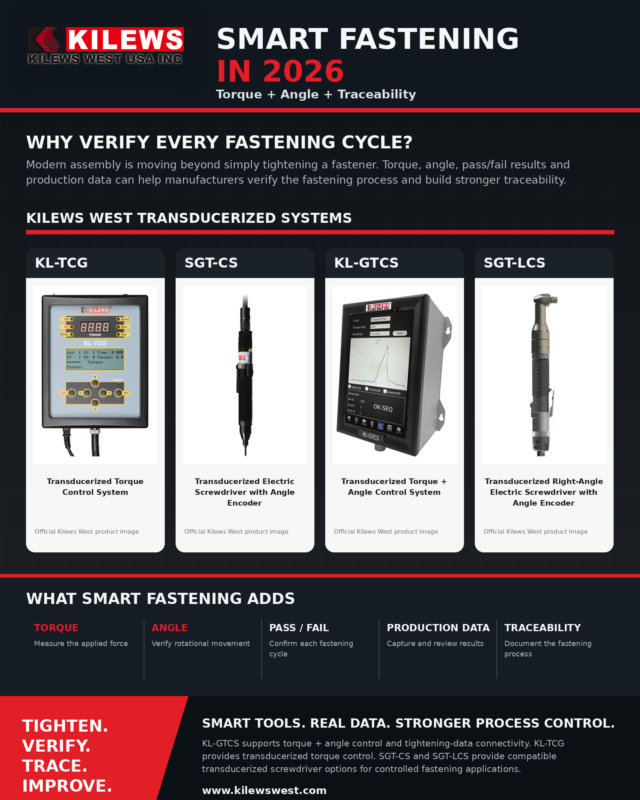
Meet the Kilews West KL-GTCS Torque + Angle Control System
The Kilews West KL-GTCS Transducerized Torque & Angle Control System is designed to provide much deeper control over the fastening process.
Rather than relying only on mechanical clutch shutoff, the KL-GTCS platform works with compatible transducerized screwdrivers to monitor fastening parameters directly.
The system allows multiple tightening parameters to be programmed, including:
Speed
Time
Thread
Direction
Torque
Angle
The KL-GTCS also includes a touchscreen HMI that allows operators and production teams to create multiple jobs and fastening sequences for different assembly operations.
This means a single fastening station can be configured for different products, stages or fastening requirements without relying entirely on manual tool adjustment.
Fastening Data Becomes Production Data
One of the most important capabilities of the KL-GTCS platform is its ability to store and communicate fastening information.
The system includes internal data storage and supports the transfer of tightening data through options including Ethernet communication, USB and FTP.
It also supports Modbus TCP communication and configurable I/O for integration with manufacturing equipment and PLC-controlled processes.
That allows fastening information to move beyond the screwdriver itself and become part of the larger production environment.
For manufacturers moving toward connected factories, automated assembly and greater process visibility, this type of communication can be extremely valuable.
SGT-CS: Transducerized Fastening With Torque + Angle Feedback
The Kilews SGT-CS Series works with the KL-GTCS Torque & Angle Control System.
These transducerized electric screwdrivers incorporate precision torque measurement along with an angle encoder, allowing the fastening system to monitor both torque and rotational movement during the fastening cycle.
SGT-CS configurations are available for different assembly requirements, including inline and pistol-grip tool designs.
Depending on the application, programmable fastening parameters can include:
Speed
Time
Angle
Direction
Torque
This gives manufacturing engineers much greater control over how a fastening operation is performed.
Instead of selecting a tool based only on torque range, engineers can build a fastening process around the requirements of the joint.
SGT-LCS: Smart Fastening for Right-Angle Applications
Not every fastener is positioned in an easy-to-reach location.
Assemblies in automotive, machinery, electronics and other industries frequently contain fasteners positioned inside confined spaces or along difficult assembly angles.
The SGT-LCS Series Transducerized Right Angle Electric Screwdrivers with Angle Encoder brings the torque-and-angle capabilities of the KL-GTCS system into a right-angle tool configuration.
The SGT-LCS Series works with the KL-GTCS system and provides programmable control over parameters including torque, angle, speed, time and direction.
This allows manufacturers to maintain greater fastening control even when the physical design of the assembly requires a right-angle tool.
Where Does the KL-TCG Fit?
Kilews West also offers the KL-TCG Transducerized Torque Control System.
The KL-TCG is designed for applications where transducerized torque control is required without the additional torque-and-angle architecture of the KL-GTCS platform.
The KL-TCG allows multiple tightening parameters to be configured, including speed, time, thread, direction and torque.
It can also be used with Kilews N-DAS software for additional setup and fastening-process management.
The KL-TCG works with the compatible SKT-CG and SKT-LCG transducerized screwdriver families.
This gives manufacturers a choice between two smart fastening approaches:
KL-TCG: Transducerized torque control
KL-GTCS: Transducerized torque + angle control
The appropriate system depends on the application, quality requirements and level of fastening data required.
Pass / Fail Results Give Operators Immediate Feedback
One of the biggest advantages of a controlled fastening process is the ability to determine whether a fastening cycle falls within established parameters.
Instead of relying exclusively on operator feel or post-assembly inspection, the fastening system can help identify whether the tightening process has produced an acceptable result.
That allows production teams to work toward a simple objective:
Every fastening cycle should produce a verified result.
When a result falls outside the programmed parameters, the system can identify the fastening operation as not meeting the established criteria.
This gives operators and supervisors an opportunity to address the problem before the product travels farther through production.
Finding an issue at the fastening station is usually far more valuable than discovering it during final inspection—or after the finished product has left the facility.
Better Fastening Data Can Lead to Better Manufacturing Decisions
The value of connected fastening is not limited to individual screws.
When tightening information is collected across hundreds or thousands of fastening cycles, manufacturers can begin identifying larger production patterns.
For example:
Are certain joints regularly approaching their programmed limits?
Is one assembly station producing more failed cycles than another?
Are fastening times changing?
Are operators experiencing repeated problems with a particular joint?
Has a production change affected the fastening process?
Data creates visibility.
And greater visibility gives manufacturing teams more information to work with when improving quality, throughput and consistency.
Smart Fastening Is Part of the Connected Factory
Industrial manufacturing continues to become more connected.
Robotics, PLCs, automated assembly systems, production software, quality-control systems and manufacturing analytics are increasingly sharing information across the plant floor.
Fastening technology is becoming part of that same ecosystem.
The screwdriver is no longer simply a motor that turns a fastener.
It can become a measurement device, a process-control tool and a source of production data.
That evolution is why torque, angle and traceability matter more than ever.
Manufacturers are moving from:
“Was the screw tightened?”
to:
“Was the fastening process completed correctly—and can we prove it?”
That is the difference between basic fastening and smart fastening.
Build a Smarter Fastening Process With Kilews West
Whether your application requires transducerized torque control or advanced torque-and-angle monitoring, Kilews West offers fastening systems designed for modern production environments.
Explore the:
KL-GTCS Transducerized Torque & Angle Control System
KL-TCG Transducerized Torque Control System
SGT-CS Transducerized Electric Screwdrivers with Angle Encoder
SGT-LCS Transducerized Right Angle Electric Screwdrivers with Angle Encoder
For help selecting the correct tool, controller and fastening strategy for your assembly process, contact the Kilews West team.
Kilews West USA
Top Quality. Excellent Service. Progressive Design.
